Image Production · Automatic Exposure Control
AEC cell selection: what the chamber sees
Automatic exposure control terminates the exposure when the selected chamber reaches a set charge. Whatever tissue covers that active cell is what sets exposure time—so cell selection and positioning matter as much as kVp.
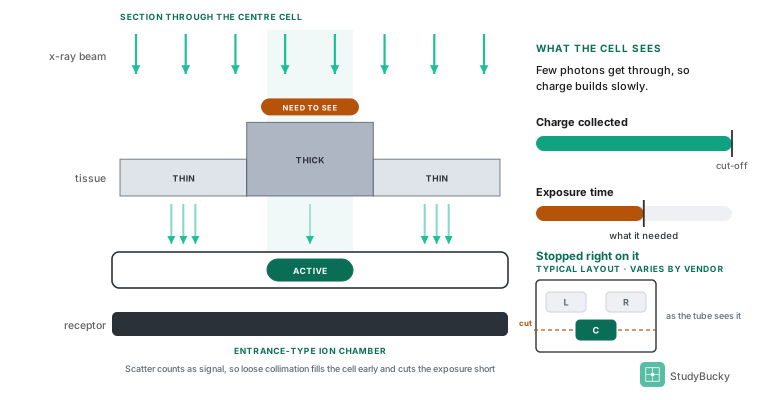
How AEC sets time
You still choose kVp, mA (or mAs station), receptor, and grid. AEC mainly controls time.
The chamber integrates radiation until the preset charge is reached, then stops the exposure.
Pick the cell under the anatomy of interest
Activate the chamber(s) under the part you need properly exposed. Centering and detector selection are classic stem targets: wrong cell = wrong anatomy driving the timer.
Why wrong tissue over the cell ruins the image
Thicker/denser tissue over the active cell → longer time → the region of interest can be overexposed.
Thinner/less dense tissue over the cell → shorter time → underexposure/noise in the region of interest.
Frequently asked questions
Does AEC control kVp?
No. AEC primarily controls exposure time. You still select kVp (and usually mA), plus receptor and grid.
What happens if the active AEC cell is under denser tissue than the area of interest?
The chamber takes longer to reach its charge, so exposure time rises and the area of interest can be overexposed.
What is the most important rule for AEC cell selection?
Put the active cell under the anatomy you need properly exposed, and center that anatomy to the selected chamber(s).
Interactive diagram
Free layer covers how AEC timing works and why cell selection matters. Unlock full access to drive chamber selection and linked practice.