Safety · Radiation Protection
Inverse square law in radiography: distance vs intensity
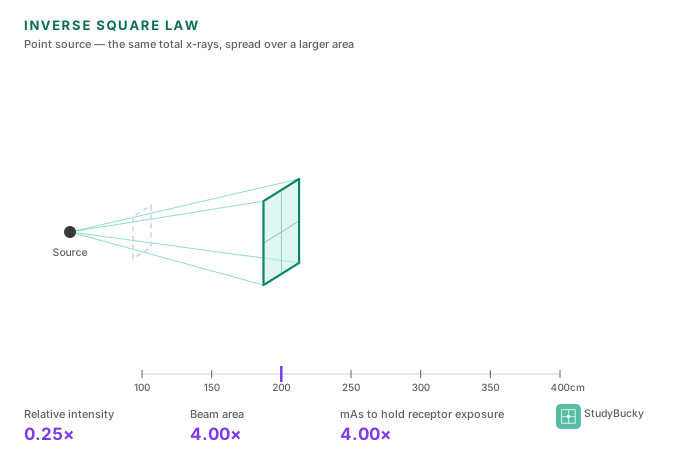
The inverse square law is the radiography rule that ties distance to intensity: I₁/I₂ = D₂²/D₁². This interactive diagram shows why doubling your distance leaves about one quarter the exposure—and when you should switch to the direct square law to keep receptor exposure the same.
Inverse square law formula (radiography)
I₁ / I₂ = D₂² / D₁²
I is intensity (stems may say exposure rate, mR/hr, mGy/hr, or air kerma). D is distance from the source. Subscripts cross because intensity and distance move in opposite directions. Distance changes how many x-rays land at a point—not their energy.
Worked example: 100 cm → 200 cm
Moving from 100 cm to 200 cm multiplies distance by 2, so the beam covers 4× the area. Intensity at any one point drops to 0.25×. Holding receptor exposure would take 4× the mAs (direct square / exposure maintenance): mAs₂/mAs₁ = (SID₂/SID₁)². Watch the denominators—in inverse square the new distance is on top for intensity; for maintenance mAs, the SID ratio is squared the other way.
Inverse square vs direct square law
Inverse square
I₁/I₂ = D₂²/D₁². Changes intensity/exposure rate with distance. Triggers: exposure rate, mR/hr, intensity at ___ m.
Direct square (exposure maintenance)
mAs₂ = mAs₁ × (SID₂²/SID₁²). Changes mAs to keep receptor exposure the same. Triggers: maintain, same receptor exposure, compensate for SID.
Inverse square and direct square on the ARRT formula sheet →
Why distance is the radiographer’s best tool
Of time, distance, and shielding, distance is usually the highest leverage: backing from 100 cm to 200 cm cuts what reaches you to about 0.25× with no lead required. The law assumes a point source; a focal spot a millimetre or two across behaves as one at clinical distances.
Frequently asked questions
What is the inverse square law in radiography?
Intensity is inversely proportional to distance squared (I₁/I₂ = D₂²/D₁²). Double distance → about ¼ intensity; half distance → about 4× intensity.
If I double my distance from the patient in fluoro, what happens to my exposure?
About one quarter, all else equal—distance is usually the highest-leverage protection move.
When do I use the direct square law instead?
When the stem says maintain or compensate receptor exposure after an SID change—adjust mAs by the square of the SID ratio. See the ARRT formula sheet.
Interactive diagram
Free preview teaches the formula and the 2× distance → ¼ intensity demo. Unlock full access to scrub distance freely and drill ARRT-style stems.