Safety · X-Ray Production
Electron interactions: how x-rays are made (bremsstrahlung & characteristic)
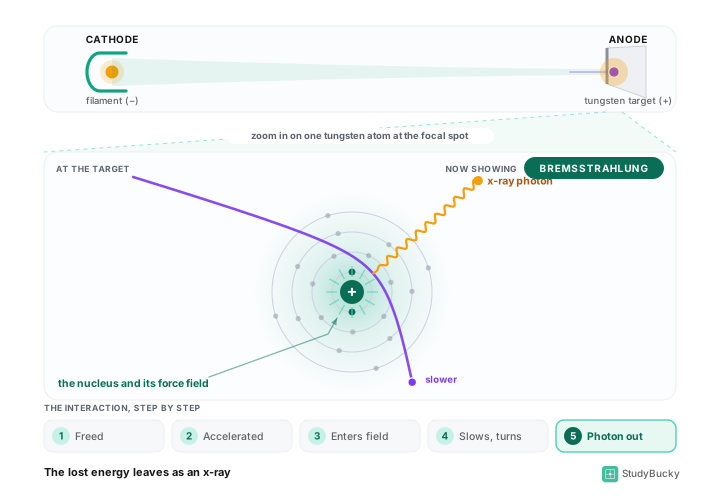
X-rays are made when projectile electrons from the cathode interact in the anode. Two outcomes matter for the ARRT: bremsstrahlung (braking near the nucleus) and characteristic radiation (after an inner-shell electron is ejected). This diagram walks one electron through both paths.
From cathode to anode
Electrons accelerate across the tube voltage and strike the target. Almost all of their kinetic energy becomes heat; a small fraction becomes x-rays.
Bremsstrahlung (braking radiation)
The electron is deflected by the nuclear field and loses energy as a continuous spectrum of x-ray photons. This is the majority of a diagnostic beam.
Characteristic radiation
If the projectile ejects an inner-shell electron, an outer-shell electron fills the vacancy and emits a discrete-energy photon. For tungsten K-characteristic, that shows up near ~69 keV once kVp is high enough. Target material sets those energies—not mAs.
Frequently asked questions
What is the difference between bremsstrahlung and characteristic x-rays?
Bremsstrahlung is a continuous spectrum from electron deceleration near the nucleus. Characteristic x-rays are discrete energies from electron shell transitions after an inner-shell vacancy.
Why is most tube energy heat instead of x-rays?
Only a small fraction of projectile-electron kinetic energy is converted to x-rays; the rest heats the anode—hence rotating anodes and heat limits.
What makes characteristic radiation “characteristic”?
The photon energies match the target atom’s shell binding-energy differences, so they are characteristic of that element (e.g., tungsten K-lines near 69 keV).
Interactive diagram
Free layer covers both production paths. Unlock full access to step the interaction and linked practice.